This is an excuse for me to ramble about intricacies of tax filing. None of this page is legal or tax advice, just fwiw. I’m writing my own experiences at this time, and may get details wrong or things may change between now and you reading this.
Taxes
Absolutely save your bank statements and payslips from the year you’re moving to Germany. Save invoices and receipts for any cost of moving (visa costs, hotels, flights, residence permit costs, etc).
You’ll likely be obligated to file taxes for your first year if you had any income while residing abroad that year. While it’s often not taxed, it counts towards “Progressionsvorbehalt” (This affects the income tax % you are taxed with, but not the amount that’s taxed. To give an example, it might push your income tax % from 30% to 35%, but that’ll still be 30% or 35% of the 10000eur of taxable income you made in Germany that year).
Tip
Generally note down the days you’re sick or on holidays, as your work day count can affect your taxes. If you’re working partly remotely, also keep record of how many days you work at home and in the office. Keep invoices for work spending, see What you can deduct and how much to expect back for what may count.
Obligation to file
You’re generally not obligated to file taxes (Abgabepflicht) unless a certain series of conditions exist. Here’s a German article on what these look like. Whether you’re obligated or not affects your deadlines alongside risking fines, I have a section on those below.
Common cases that may affect you are:
- Any untaxed income
- Most commonly foreign income, regardless of if you’re a tax resident in DE or not during the income
- This also affects capital gains (incl. interest) from banks or brokerages in other EU countries, this includes bunq, etc.
- This also affected me when a past job paid my yearly bonus too late into the next year after I had started a new job, and it couldn’t be counted towards the past year anymore and my new job didn’t alter my total yearly earnings to account for that, so I owed taxes (and went and paid ~850eur next year). Notably this should’ve had “Sonderzeichen S” but didn’t, so don’t just count on its presence.
- Any form of social income: Unemployment pay (ALG), shortened work (Kurzarbeit), sick pay (Krankengeld, only relevant if you were sick for a really long while), maternity pay (Mutterschaftsgeld), parental pay (Elterngeld)
- Changing employers within the tax year, without the new employer properly accounting for the income from old employer
- You are self employed or a business owner
Tip
Hold onto your payslips from any company while working in Germany, especially the Lohnsteuerbescheinigung (the yearly one, though that’ll also be sent to ELSTER).
Deadlines and late-filing fines
The types of deadlines that exist are as follows (please check the actual “Abgabefrist” for the tax year you’re filing for):
- If obligated to file, and filing without a tax advisor: Often 31st of July of the year after
- Example: For FY 2025, this is 31st of July, 2026
- If obligated to file, and filing with a tax advisor: Often last day of February of 2 years after
- Example: For FY 2025, this is 1st of March, 2027, as the last day of February is a Sunday.
- You don’t often need a “real” tax advisor, and it’s unlikely you’ll find one. They’re often overworked and don’t take new customers last minute unless they’re high earners (e.g. one in Munich was only allowing >100k/yr income back in 2023).
- Various self-filing services offer a “workaround” of you preparing your return, a tax advisor working for them checking it and filing it on your behalf, which lets you use the later deadline. This costs more, but if the expectation is that you’ll owe money (and as such are risking a mandatory fine), you may save money by doing this.
- If not obligated to file: Often 4 years.
- Example: For FY 2025, this is 31st of December 2029.
Late filing fines (Verspätungszuschlag) are currently primarily described in Abgabeordnung § 152.
Notably there’s two main types of late filing fines:
- Discretionary
- If you file after the deadline, the case worker at Finanzamt may choose to impose a fine.
- You might be able to avoid this by attaching an apology to your within the added information textbox in your tax return. I filed my mandatory ESt 2022 all the way in 2025, but attached an apology stating that I didn’t know I had to file it, and that I filed as soon as I found out, promising that I’ll be more careful in the future, and wasn’t fined. This would’ve qualified for a mandatory fine if I owed them money.
- Mandatory
- If you file 14 months past the deadline (like I did with my ESt 2022), and you owe money (AO § 152 Abs. 3), there’s a mandatory fine. If you’re only getting back overpaid taxes, then you’re not likely to face this (e.g. an item you’re claiming may get struck out if decided to be not tax deductable, pushing you back to owing money).
The fine is up to 0.25% of the assessed tax per started month of delay, with a minimum of 25EUR per month. The maximum is capped at 25000EUR.
Further fines may apply if you get reminders to file from Finanzamt via a letter.
Worst case scenario: If you’re obligated to file, you don’t file it, Finanzamt doesn’t remind you within the statute of limitations (Festsetzungsverjährung, I believe this is 7 years?), and you would’ve owed them money, you still risk tax evasion charges for a long time (13 years, I think?). What I’m saying is that you should go file so you don’t even have to think about these things. If you’re way overdue and would owe money, consider actually involving a real tax advisor if not a lawyer.
How to file
I don’t recommend Taxfix, as back when I used it, they didn’t have great support for some common cases for immigrants, like still having your rental abroad ongoing (which is reasonable if you’re moving things and cleaning up over time, or just feeling out a new country while you’re within your notice period). They also charged me significantly more than the software I use today. They do support English.
I am currently using WISO Steuer (not https://play.google.com/store/apps/details?id=de.buhl.steuerphone&hl=en_US). I use the web app and the android app, not the desktop apps. It’s very good, but it’s in German. Translation software works fine with it, and the ? button is very helpful to understand any given field. You can prepare a filing without a license, so you can give it a try for free. I’d suggest getting your license online, amazon tends to sell them for 20-25EUR, but honestly this stuff is just wall to wall at mediamarkt so maybe also check other places, see idealo etc. Remember that you want the license for the year you’re filing for (e.g. 2023 if you’re filing taxes of 2023).
(Small note: WISO/Buhl offers many tax filing software at different levels of complexity and different feature sets. I have only tried this one, but from looking at comparisons, it’s the better option among their offerings when considering feature set and price tag. Don’t confuse WISO Steuer with the confusingly named Buhl tax, latter is a simplified software. (Buhl is the developer of WISO))
For foreign income, IIRC you need to declare the pre-tax income, which can be difficult to determine if it is years in the past and you haven’t kept rigorous records of your payslips. You need to use the European Central Bank’s conversion rates for the day you received it, and this can also be an issue by itself (my banks abroad required quite a lot of hassle to get me bank statements older than 2 years). This is why I suggest you to assemble and hold onto these documents ASAP.
If you want to file with a person, consider a Lohnsteuerhilfeverein (Income Tax Help Association) in your area. Do mention complicating factors to them before you pay (any foreign income, any side income, any foreign residences, etc) as they may not cover all cases.
What you can deduct and how much to expect back
For most tax deductible things, the amount is deducted from your taxable income. This means that e.g. if you have an income tax rate of 42%, you get up to 42% of the tax deductible cost back (it’s “up to” as if you deduct enough, your income tax % will go down, and also for most items there’s a minimum total that must be reached before it actually starts deducting).
Many people misinterpret this as they’ll get back the VAT (MwSt/USt), that’s not the case. It’s fine though, you’ll often get back more than just the VAT.
Hint
If you’re married (+ living together) and not making about the same amount of money, then you can jointly file and get a preferential tax treatment. As far as I understand, your tax limits get joined, and so if one of you is making 90k and the other 20k, you can get taxed as if you’re earning 55k each. You should very strongly consider filing every year if you’re married. Worst case, you get to the end of the tax preparation estimate, it says you’re not obligated to file, you decide that it’s not worth the 5 euros you’d get back, then don’t pay for the software license to file.
Common deductions I do/did are:
- Purchases/costs for work, if not paid back by work (these often get a % of “usage for work”)
- Computer peripherals: Headphones / Webcam / Mouse / Keyboard / Printer / Monitor / Privacy Screen, etc
- I successfully claimed 13% of my wifi access point upgrade at home, as that’s the % of the awake time we work remotely per year among all the people living in this flat.
- Visas and residence permits
- Yes, you can offset your work visa and residence permit! Cite
Finanzgericht Nürnberg Urteil v. 09.08.2017 - 5 K 815/15.
- Yes, you can offset your work visa and residence permit! Cite
- Work travel costs
- Work trips: Food (up to a limit), hotel, transportation, visa, etc.
- Traveling to office: Public transport tickets, potentially a flat rate if driving
- This has quite a lot of details and other cases, don’t take any of this super literally, I’m just trying to create an image of “hey, you may be able to get these back, check details for your case”.
- Stationary
- Software subscriptions (code editors, IDEs, etc)
- Computer peripherals: Headphones / Webcam / Mouse / Keyboard / Printer / Monitor / Privacy Screen, etc
- Costs of moving for work
- This has a lot of potential for offsetting your Progressionsvorbehalt on your first year! Flights, looking for a house (hotel and transport), double rent, etc may be able to be deducted.
- Home office flat rate if working remotely
- This is per day and is why you’ll want to keep count of your vacation days, office days and sick days.
- Workroom costs if working remotely
- Arbeitszimmer is very nice tax-wise but it’s hard to meet its requirements (must be above a % usage for work, cannot have a bed, must have a door, etc)
- Phone line also used for work, internet usage counts (not in full)
- Bank account fee (not in full)
- Tax software costs
- Donations or membership fees to tax-deductible organizations within EU
- If you’re a member of a union (Gewerkschaft) this is also deductible.
- Costs of looking for work
- Travel, hotel etc where appropriate.
- You can claim a flat rate per application. If you applied for a lot of jobs and can prove it (emails, etc), you might want to go for it.
This is only the tip of the iceberg. There’s more you can deduct that may fit your case (e.g. healthcare spending above a certain amount, funeral costs) that I never even thought of for myself. File honestly, and be ready to provide proof for anything if requested. Claims may get struck out by the Finanzamt, as long as you weren’t fraudulently claiming something, that’s fine.
With careful record keeping of what I spend my money on over the year, I so far averaged ~600eur/yr in tax returns.
Housing
Good luck with the search :D
Security deposits (Kaution)
- It cannot exceed 3x the monthly rent (BGB § 551 Abs. 1)
- It can be paid in 3 equal monthly installments (BGB § 551 Abs. 2)
- Landlords may be unhappy and not sign the rental contract if you mention this. Don’t mention it until it’s signed.
- It must be kept in a savings account with 3 month notice period unless agreed otherwise in writing, and separately from the landlord’s own assets in any case (BGB § 551 Abs. 3)
- You’re entitled to this interest, and when you’re leaving, the deductions must account for this, and if you have leftover interest, it must be returned to you.
- If the landlord doesn’t do this, there’s a standard average interest for these accounts (and it’s hella low), you can claim that they didn’t fulfill their legal requirements and should add that difference out of pocket.
- There’s case law on how long it can take for you to get it back (it must be reasonable, this is often considered 3-6 months). There are legal limitations on what can be deducted.
- They must pay you back the amount that’s not in question (e.g. if they’re waiting on utility bills to arrive for the year, they can deduct an estimated amount + some headroom, then must pay the rest to you. They must then pay the difference once they have the necessary invoices.).
- They must provide you with proof of what was deducted, through invoices etc.
- Send a Mahnung (legal payment reminder) if they don’t pay you within legal deadlines. You can find templates online. Use a tracked letter (Einschreiben). Follow process carefully, you can also report them to Schufa or go through a simple court process to make them pay. Don’t wait too long, there’s a statute of limitations of 3 years (BGB § 195).
- You’re entitled to this interest, and when you’re leaving, the deductions must account for this, and if you have leftover interest, it must be returned to you.
- Contract deviations from these to the detriment of the tenant are invalid (BGB § 551 Abs. 4)
- This is to say, just because they wrote that you must pay immediately in full doesn’t mean that you’re actually legally obligated.
- They may try to still withhold keys or argue that the contract was invalidated from your actions, this isn’t legal, go talk with a lawyer, and carefully document your costs due to this (any hotel costs, any lawyer costs) as it may be possible to make the landlord pay for the damages.
- This is to say, just because they wrote that you must pay immediately in full doesn’t mean that you’re actually legally obligated.
- You also cannot be required to pay rent or deposit at/before signing, you can pay before you move in (BGH 03.12.2003 Az. VIII ZR 86/03).
- Again, landlords may be unhappy if you state your intentions about this before things are signed.
Also check out if your area has a rent limit law. It’s often not followed by landlords, and I wouldn’t suggest exercising them if you have a private landlord, but as corporate landlords have stricter requirements for cancelling a rental contract, you can use these laws to assert that your rent was illegally set and reduce it to the legal maximum. Do talk with someone more knowledgeable, like a local Mieterverein.
Address Registration
- They must let you register at the address. If they don’t do this, ask for the necessary documents to register in writing (Wohnungsgeberbestätigung), go to your appointment to register at this address within the legal deadline, and state that your landlord is refusing to issue the necessary documents to register. The city will then chase after your slumlord to make sure they follow the law going forward.
- The right to live and register there only extends to the people whose names are on the rental contract as people who will be living there. If the living space is large enough (local laws apply), having immediate family move in is also allowed, for the rest restrictions apply (BGB §553 Abs. 1). For unmarried partners, desire to form or continue a long-term shared household may be sufficient legitimate interest.
- They may limit their approval to agreement on an appropriate increase in rent (BGB §553 Abs. 2).
- The right to live and register there only extends to the people whose names are on the rental contract as people who will be living there. If the living space is large enough (local laws apply), having immediate family move in is also allowed, for the rest restrictions apply (BGB §553 Abs. 1). For unmarried partners, desire to form or continue a long-term shared household may be sufficient legitimate interest.
- They must let you have your name on the postbox. They can decide on format, design, material etc, but they cannot prohibit it outright. There may be others’ name on it and you cannot object to that (e.g. name of the person you’re subletting from).
- One may not open, destroy or withhold other people’s mail. That’s a crime.
Utility cost pre-payments within rent (Vorauszahlungen für Betriebskosten)
§ 556 BGB is what currently governs this.
- It cannot be too high. (§ 556 BGB Abs. 2, “Vorauszahlungen für Betriebskosten dürfen nur in angemessener Höhe vereinbart werden.“)
- It must be balanced yearly, they cannot pocket any money you overpay. (§ 556 BGB Abs. 3, “Über die Vorauszahlungen für Betriebskosten ist jährlich abzurechnen; dabei ist der Grundsatz der Wirtschaftlichkeit zu beachten.“)
- You have 12 months to object after receiving the bill. (§ 556 BGB Abs. 3, “Einwendungen gegen die Abrechnung hat der Mieter dem Vermieter spätestens bis zum Ablauf des zwölften Monats nach Zugang der Abrechnung mitzuteilen.“)
- You can demand to see the bills and other relevant documents (§ 556 BGB Abs. 4), but this is the one clause that your contract can deviate from to your detriment (§ 556 BGB Abs. 5), that doesn’t go for the rest.
If your landlord is demanding you pay too much, send them a formal objection as an Einschreiben letter (hold onto the tracking code, take a picture of the signed letter within before you send it, just in case). You may want to use a template like this one.
Flat-rate utility costs within rent (Nebenkostenpauschale)
See § 560 BGB.
Residence Permit Online Functionality
You’ll get a PIN letter. Use Ausweisapp2 on your phone, you can also install it on your PC and connect it to your phone. Set a PIN and don’t forget it. It comes in useful.
Online reviews and slander
I don’t know why this is such a big deal for me to put in here but it is :)
Germany has very careful laws around this, and Google Maps reviews are sometimes taken down by businesses if your review isn’t sufficiently proving your claims. This includes lack of proof that you were there in the first place. Take a picture of the receipt and put it in your review.
Here’s an article on it. I personally don’t trust star ratings of any business that only has good reviews.
I had a review taken down in which I merely said that the cappucino of a diner wasn’t good :) It was a review from 2 years ago and the place was cash-only, so I sadly had no proof to take them to arbitration with.
Generally don’t write about any impossible to prove claims. “I had food poisoning from here” is hard to prove unless you only had food from there within the last 24 hours and had a doctor’s report confirming food poisoning, a review like “I had some stomach pain within hours of having food here” is much easier to defend.
Update (24.04.2026): Google Maps now shows how many reviews were removed due to this. You may need to use web on a PC (or mobile desktop mode), though eventually it should land on the mobile apps.
Traveling abroad
Do note that your residence permit will be assumed to be given up if you travel abroad for longer than a certain period without permission. You can get a special permission if you have a good reason (e.g. mandatory conscription), you must get this before you travel abroad.
The limit for remaining abroad, at the time of writing:
- 6 months for most residence permits
- 12 months for EU blue card
- 6 months for settlement permits, Niederlassungserlaubnis
- Some people say that having a blue card and settlement permit simultaneously changes it to 12 months. This does not match my legal reading, you might be able to lose the settlement permit but not the EU blue card in this case. Yes, this means that going from an EUBC to a settlement permit may have one singular downside.
- and then there’s EU permanent residence permits, Daueraufenthalt-EU (which is not the one people commonly refer to as permanent residence)
- Outside EU: 12 to 24 months (24 if you had a blue card before). AufenthG § 51 Abs. 9, Nr. 3
- Inside EU: 6 years outside Germany (I believe this is counted as non-residence, not non-visit). AufenthG § 51 Abs. 9, Nr. 4
If you’re a refugee or similar, you probably cannot travel to your state of nationality without losing your protected status, check with your case worker where appropriate.
Technically, you’re only allowed to spend 90 days out of 180 within other Schengen countries, same as if you had a Schengen visa or a visa waiver. There’s no detection or enforcement mechanism for this, but to be honest, if you want to spend so much time in another country, why fake your residence in one country?
Unemployment pay (ALG)
You can get unemployment pay as a foreigner. You qualify for it by working a certain amount, same rules as citizens apply. If you quit or agree to a separation contract, you get a 3 month block (limitations apply). allaboutberlin (great resource, even outside berlin) has a good page on the topic of losing your job or quitting it, so you should 100% read it.
I’ve done it on a blue card for 2 months.
Here’s some things to keep in mind to apply:
- You’ll want to inform the foreigner’s office soon after knowing when you’ll be unemployed.
- You’ll want to register with the Arbeitsagentur for a variety of things early on (see allaboutberlin link), else you may get penalized (x weeks/months before you get unemployment pay).
- Important: You’ll want to send the application for unemployment pay either on the day or within last 2 weeks of your job, else you’ll only qualify for ALG from the day you applied.
- If you have any incorrect info on your profile (e.g. mine said german, had wrong gender, old Rentenversicherung number, wrong marital state), you can go to your responsible Arbeitsagentur bureau and get them to fix it. I tried doing it via a ticket on their site but they took over a month, doing it IRL took <30 minutes.
- If there’s a good reason why you couldn’t’ve applied earlier, state it in your application. I applied halfway into the first month of unemployment due to the information mismatch on my profile (which was reflected in the forms for ALG, and applying requires me to certify that everything is correct), stated this as a reason for late application, and they approved ALG for the entire period.
- You can only remain unemployed for a certain amount of period before you lose your residence permit. This is often 3 months, even if you qualify for ALG for much longer.
Here’s some repercussions to keep in mind:
- If it’s for a short enough period among a larger period of paying for yourself, it’s unlikely to affect your process of getting a settlement permit. This is up to the case worker to my knowledge.
- I’ve done this, got my settlement permit after 48 months of residence (with an EUBC), 2 of those months I had received ALG on. I declared this in my application, the case worked asked what’s up, I said I was on ALG and had been employed before and after, she deemed as sufficient for deciding that I’m financially stable.
- It should also not have too much of an impact on citizenship. StAG § 10 Abs. 1, Nr. 3 currently states that you must not have recourse to certain types of public funds, specifically SGB 2 (Bürgergeld, Grundsicherung) and SGB 12 (Sozialhilfe) you must have been full-time employed for 20 of the last 24 months for recourse to public funds to be considered fine.
Health insurance
todo! tl;dr: you probably don’t want private.
Losing your residence permit abroad
tl;dr: don’t, it appears to suck.
You’ll have to deal with local german consulate, their policies may be different. The turkish one states that you need a Meldebestätigung from last 6 months, which is an absurd-sounding requirement considering that you need to go to a Bürgerbüro in Germany to get one of those (and who’d travel with that?), so I strongly suspect you do not in fact need it (besides, it’s in AZR).
Prepare to stay longer than you intended. You’ll want to maybe get them a police report and if you have pictures of scans (which you should!), a photocopy of your previous residence permit. They’ll have to chat up the Ausländerbehörde in the city of your residence, even if you had a settlement permit and it shows up in AZR.
Settlement permit things (Niederlassungserlaubnis, colloquially permanent residence)
Benefits
Common ones people bring up is the ability to work ~any job, protection from being kicked out in most cases, ability to change the reason to stay for any reason (e.g. start studying), and overall more trust for things like loans. Depending on what residence permit you were on, you may not qualify for citizenship until you switch to a settlement permit.
I’ll document the rarer cases as I run into them :)
- If you’re an amateur radio operator, the Rufzeichenplan (link prone to breakage) states that call signs can only be issued until expiry of residence permit if it is not a permit without an expiry (like Niederlassungserlaubnis).
- BNA Dortmund is super overworked and appears to be unaware of this themselves, so this is unlikely to matter in practice. I applied via post and had my EUBC included, and got an assignment without expiry. My gf, whomst work residence permit holder, applied online and they just put german into the citizenship field on the issued license, also without expiry.
- If your country of nationality has a conscription, it may have benefits for delaying or overall just avoiding it.
- Republic of Ireland used to waive visa fees for settlement permit holders of UK and Schengen countries. This changed on June 2023 to only UK :( See before and after.
Downgrades from EU Blue Card
- See Traveling abroad section, you can travel abroad for 6 months with a settlement permit and 12 months with an EU blue card. One can expire before the other, to my understanding. Even if this isn’t spotted in the moment, it may be investigated and cancelled in the future.
- Your EU blue card mobility options are not there unless you keep both. This is not a super nice path, you basically can apply for an EUBC in another EU country under their laws and requirements without the need to go to a consulate, but by just moving to that country, and very few utilize it.
The rest appear to be just upsides, unless you care for leaving Germany and getting back your pension money, where I hear there’s more complications.
Having both a settlement permit and EU Blue Card
See this post.
- My NE Zusatzblatt (from Hamburg) notes that I am also an EUBC holder until 2032, friend’s (from Berlin) from last year says former holder of EUBC. Some people online say you have to explicitly ask to have both (neither of us did), some people say that they were offered an explicit option (e.g. Munich).
- My EUBC was expiring end of Feb 2028, I guess they renewed it for 4 years when issuing my NE, the Zusatzblatt says mid Feb 2032. (my NE card expires in 2032)
- You appear to have a legal right to have both simultaneously, see the linked post above for details and how to assert it.
- Notably, you can lose your EU blue card if you stop meeting its conditions. This can be being out of work for too long, studying, etc. You’ll keep your NE unless you also stop meeting its conditions (mostly around remaining in Germany).
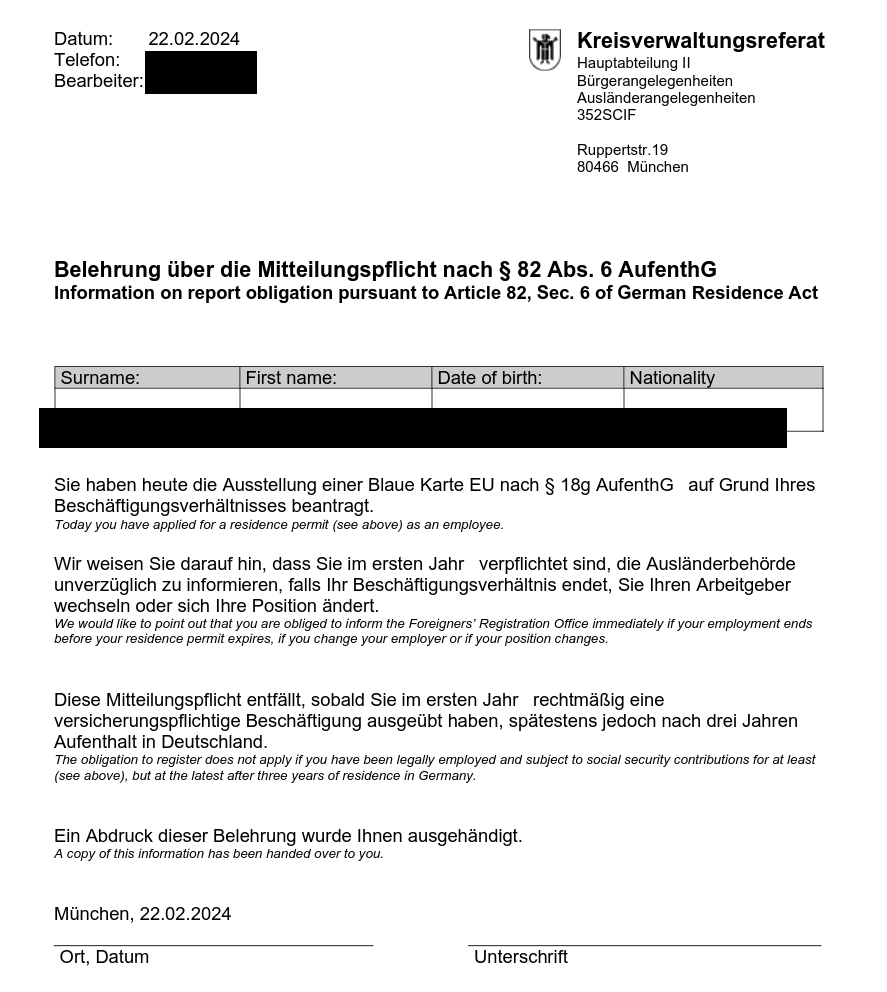
- If you do keep both, you’ll retain your EU blue card mobility options and associated protections, but you’ll be bound by the Mitwirkungspflicht (~cooperation requirements) of the EU Blue Card. You’ll have to inform them within 2 weeks whenever you’re losing your job.
- Hamburg didn’t inform me about my Mitwirkungspflicht when extending and keeping the EUBC, which I believe is a mistake on their part, as § 82 Abs. 3 requires them to. It could be argued that Hamburg trusted that Munich made me sign the paper about my knowledge of this when first issuing an EUBC (which they did), but not letting me know that it keeps going even with NE feels like an oversight.
Moving out
Absolutely have an ELSTER account (ideally the .pfx, but ElsterSecure is probably fine too), and also download a copy of your Rentenversicherungsverlauf. You may need these if you need to file taxes without sending paper forms in a letter.
You might be able to get your social security contributions back after a few years, and having your Rentenversicherungsverlauf document may help with this. See e.g. this link, keyword you want is “Beitragserstattung bei Auslandsaufenthalt”. This has some conditions you should check out before counting on it, like not being able to pay contributions anymore (can’t do it if you naturalize) or moving to a country that doesn’t share a pension system (it’s more complex than this, but I know this covers at least EU and UK).
You may want to do an explicit Abmeldung before you move out, so you can give proof of that while ending contracts (e.g. phone line) which may allow you to claim extraordinary circumstances. Hold onto that document, it may be relevant for any contracts you forgot about or if you ever want to move back to Germany again. Do read the information around this carefully so you don’t do an Abmeldung too early and put your residence status to jeopardy too early.
TODO
Here’s some topics I feel confident in talking about and might eventually write down, do reach out if you’re interested in me writing these down faster.
- Trans topics: Using Selbstbestimmungsgesetz to change name and/or gender marker.
- Trans topics: Getting diagnosis and prescriptions.
- ADHD topics: Getting diagnosis and prescriptions.